

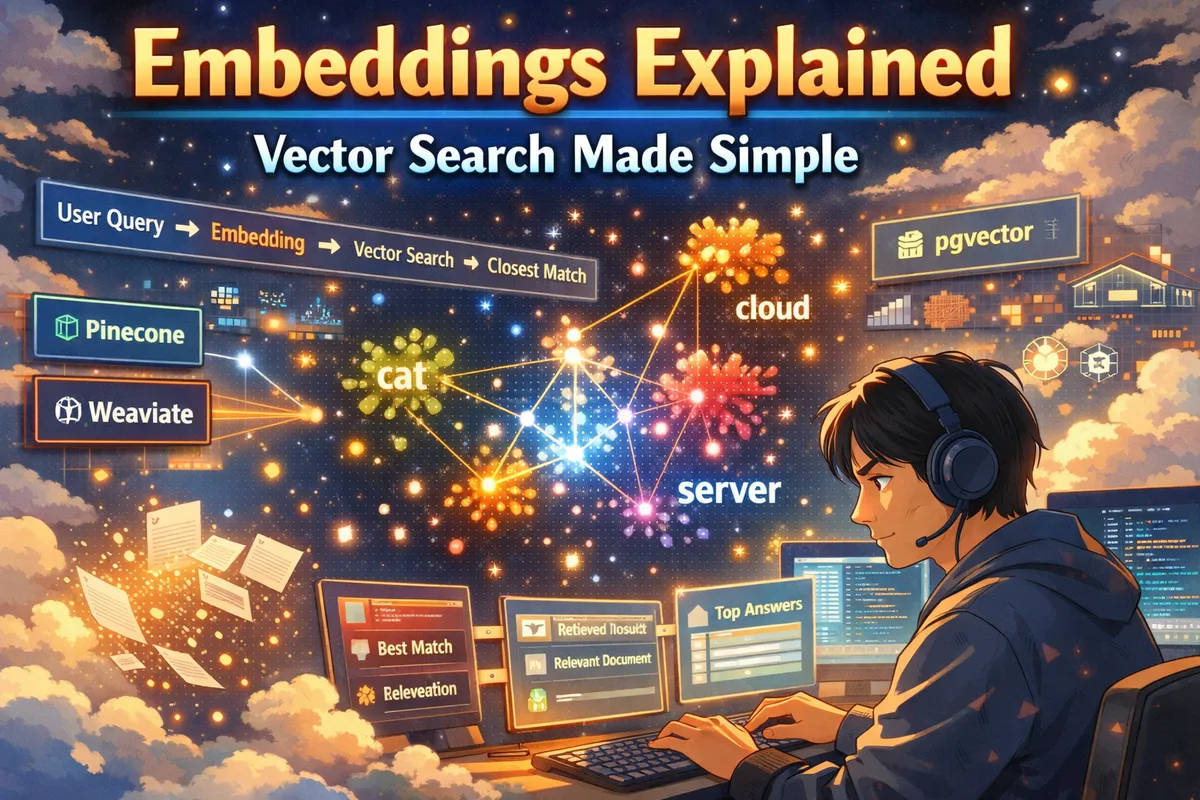
Understanding embeddings and vector databases enables us to design scalable AI-powered systems like semantic search, RAG pipelines, and intelligent monitoring that go beyond traditional keyword-based approaches.
It also helps in optimizing infrastructure, storage, and retrieval performance for modern AI workloads where context, similarity, and low-latency querying are critical.
⚡ Quick Reference
Keep the momentum going — everything you need on LearnXOps in one place:
- 🎓 Courses — Video courses & AI-built courses
- 📚 Ebooks — Community ebooks & your own
- 🧪 All Labs & Challenges — DevOps, Cloud, SRE & more
- ☸️ Kubernetes Labs & Playground — kind clusters, playground & challenges
- 🤖 AI Agent & Bot Labs — OpenClaw · Hermes · CrewAI · LangGraph · MCP
📚 Key Learnings
- What Are Embeddings?
- Why Embeddings Matter
- How Embeddings Work
- What is a Vector Database?
- Popular Vector Databases
- RAG (Retrieval-Augmented Generation)
🧠 Learn here
Modern AI applications are no longer just about storing and retrieving exact matches of data; they are about understanding meaning. This is where embeddings and vector databases come into play. They enable systems to perform semantic search, recommendation, anomaly detection, and intelligent retrieval by understanding the context behind data instead of just keywords.
This is becoming foundational knowledge as AI-powered systems, RAG pipelines, and intelligent observability tools are rapidly entering production environments.
What Are Embeddings?
Embeddings are numerical representations of data (text, images, audio) in the form of vectors.
A vector is simply an array of numbers:
Example:
"Kubernetes is scalable" → [0.12, -0.98, 0.45, ..., 0.67]
These numbers are not random — they capture semantic meaning.
Key Idea
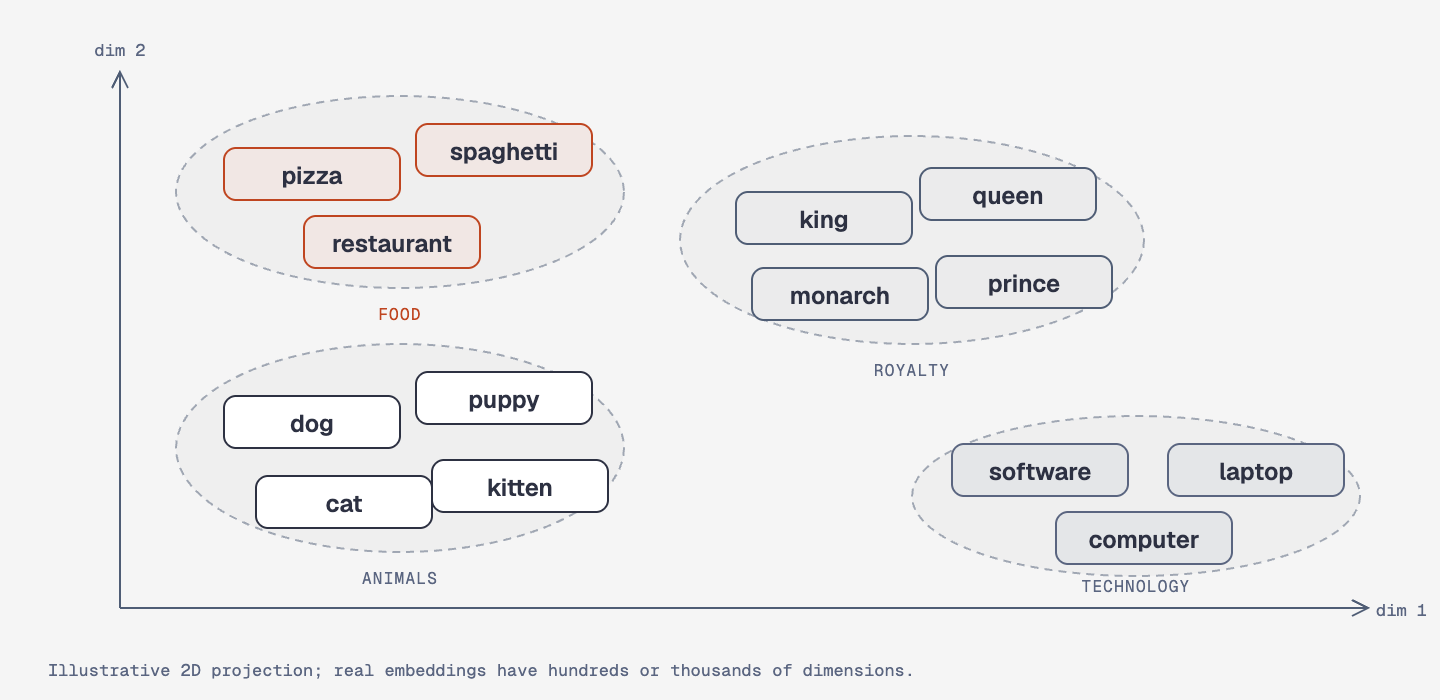
Similar meanings → Similar vectors
For example:
- "Deploy app to Kubernetes"
- "Run application on K8s"
Even though the wording is different, embeddings will be close in vector space.
In simple words:
an embedding places similar things near each other in that numeric space
When you take a piece of text and run it through an embedding model (like OpenAI’s text-embedding-3), it converts that text into a point in high-dimensional space.
- Spatial Logic: Words or sentences with similar meanings are placed close together.
- Contextual Nuance: In a 1,536-dimensional space, the vector for "King" is mathematically closer to "Queen" than it is to "Apple."
Why Embeddings Matter
Traditional systems rely on:
- Exact keyword match
- SQL queries
- Regex-based filtering
But these fail when:
- Users phrase things differently
- Synonyms are used
- Context matters more than exact words
Embeddings solve this by enabling:
1. Semantic Search
Instead of matching words, you match meaning.
Query:
"How to scale pods?"
Results can include:
- Horizontal Pod Autoscaler docs
- Karpenter scaling guides
- Cluster autoscaling articles
Even if "scale pods" is not explicitly written.
2. Recommendations
Netflix, YouTube, e-commerce — all rely on vector similarity.
3. Clustering & Classification
Group similar logs, alerts, or incidents automatically.
4. Anomaly Detection
Detect unusual patterns in metrics or logs.
How Embeddings Work
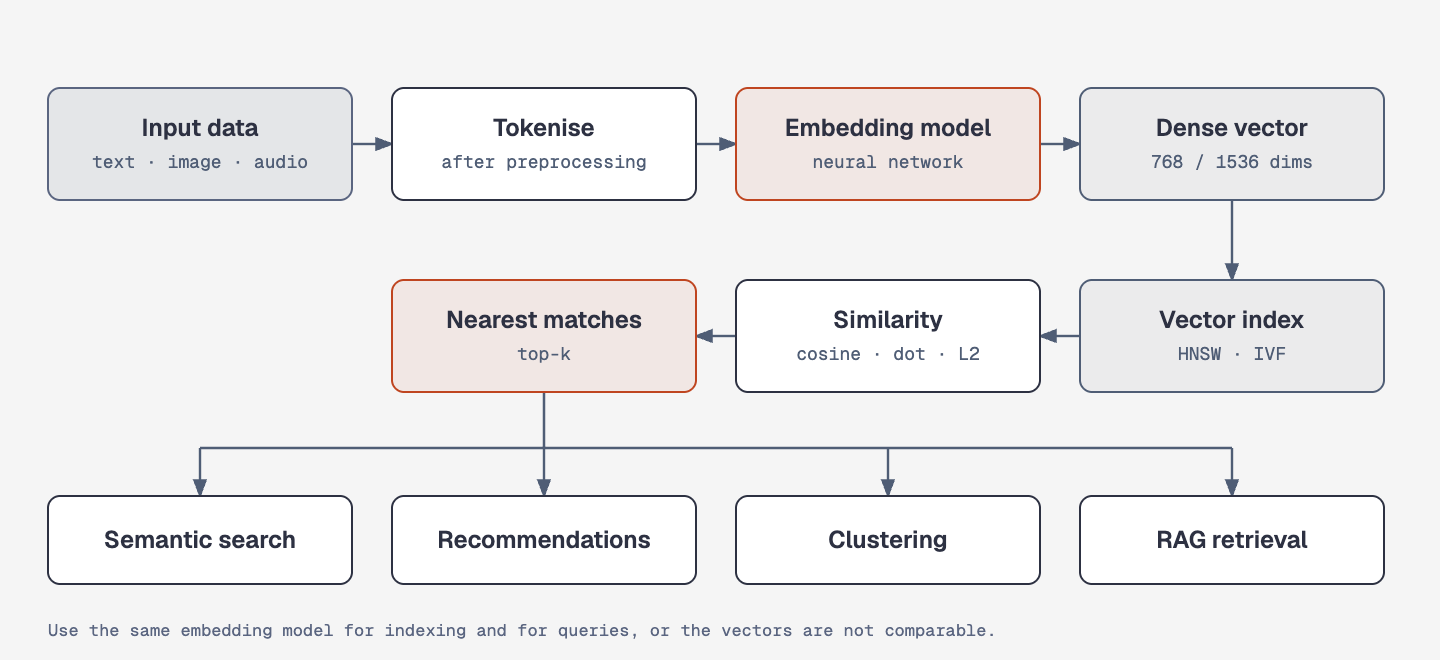
- Input text is tokenized
- Passed through a neural network (LLM or embedding model)
- Converted into a dense vector (e.g., 768 or 1536 dimensions)
The position of the vector in multi-dimensional space represents meaning.
Vector Similarity: The Core Concept
To compare two embeddings, we calculate similarity.
Common Methods
- Cosine Similarity (most popular)
- Euclidean Distance
- Dot Product
Intuition
- Closer vectors → Higher similarity
- Farther vectors → Less similarity
What is a Vector Database?
A vector database is designed to:
- Store embeddings efficiently
- Perform fast similarity search
- Handle high-dimensional data
Unlike traditional databases, they are optimized for:
- Nearest Neighbor Search (k-NN)
- Approximate Nearest Neighbor (ANN)
Why Not Use Traditional Databases?
Traditional DBs (MySQL, PostgreSQL without extensions):
- Not optimized for high-dimensional search
- Slow similarity queries
- No indexing for vectors
Vector databases provide:
- Specialized indexes (HNSW, IVF, PQ)
- Millisecond-level search, even across millions of vectors
- Scalable retrieval systems
Popular Vector Databases
1. Pinecone
- Fully managed vector database
- Easy API-based usage
- Handles scaling, indexing, and replication
Best for: Production SaaS applications with minimal infra overhead
2. Weaviate
- Open-source + managed
- Built-in ML modules
- Hybrid search (BM25 keyword + vector)
Best for: Flexible architectures and hybrid queries
3. pgvector (PostgreSQL Extension)
- Adds vector support to PostgreSQL
- Simple to integrate into existing systems
- HNSW and IVFFlat indexes for approximate search
Best for: Teams already using PostgreSQL
RAG (Retrieval-Augmented Generation)
This is where vector databases shine.
Flow:
- User asks a question
- Convert question → embedding
- Retrieve relevant documents from vector DB
- Send context + query to LLM
- Generate accurate answer
This reduces hallucinations and improves factual accuracy.
DevOps Use Cases
1. Intelligent Log Search
Search logs by meaning, not exact keywords.
2. Incident Resolution
Find similar past incidents automatically.
3. AI Documentation Assistant
Ask questions on internal docs.
4. Security Analysis
Detect unusual patterns in logs.
5. ChatOps + AI Bots
Context-aware Slack/Teams assistants.
Performance Considerations
- Embedding dimension size affects storage and speed
- Index type (HNSW vs IVF) impacts latency
- Batch embedding improves efficiency
- Caching frequent queries reduces cost
Cost Considerations
- Embedding generation cost (LLM API)
- Storage cost (vector DB)
- Query cost (similarity search)
Optimization strategies:
- Chunking documents efficiently
- Deduplication
- Hybrid search (keyword + vector)
Embeddings and vector databases are becoming the backbone of modern AI systems, enabling machines to understand meaning rather than just text.
For us, mastering this layer unlocks the ability to build intelligent, scalable, and production-ready AI systems that go far beyond traditional infrastructure capabilities.
⚡ Quick Reference
Keep the momentum going — everything you need on LearnXOps in one place:
- 🎓 Courses — Video courses & AI-built courses
- 📚 Ebooks — Community ebooks & your own
- 🧪 All Labs & Challenges — DevOps, Cloud, SRE & more
- ☸️ Kubernetes Labs & Playground — kind clusters, playground & challenges
- 🤖 AI Agent & Bot Labs — OpenClaw · Hermes · CrewAI · LangGraph · MCP


Member discussion