
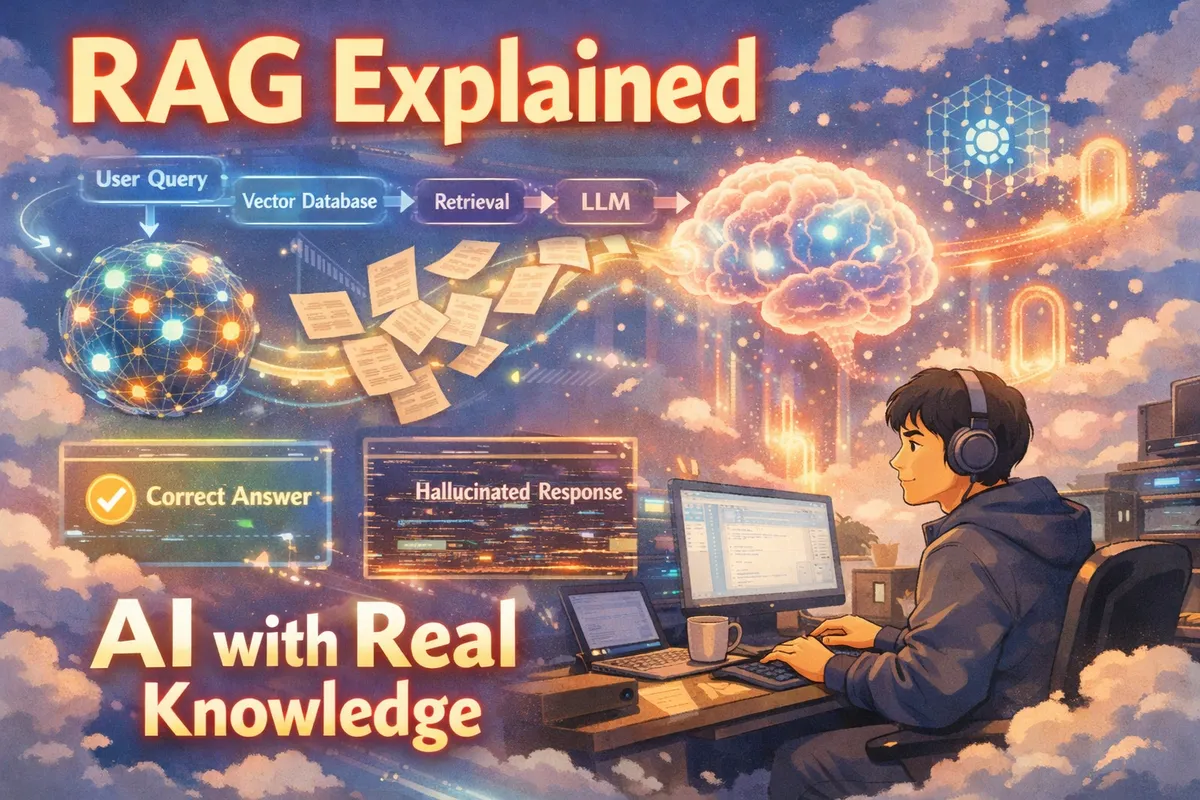
RAG enables us to build AI systems that are accurate, context-aware, and production-ready by integrating real-time data sources instead of relying only on static models.
It also introduces new infrastructure patterns—vector databases, retrieval pipelines, and observability for AI—making it a critical skill for designing scalable, reliable AI-powered platforms.
⚡ Quick Reference
Keep the momentum going — everything you need on LearnXOps in one place:
- 🎓 Courses — Video courses & AI-built courses
- 📚 Ebooks — Community ebooks & your own
- 🧪 All Labs & Challenges — DevOps, Cloud, SRE & more
- ☸️ Kubernetes Labs & Playground — kind clusters, playground & challenges
- 🤖 AI Agent & Bot Labs — OpenClaw · Hermes · CrewAI · LangGraph · MCP
📚 Key Learnings
- What is Retrieval-Augmented Generation (RAG)?
- How RAG Works: The Full Architecture
- RAG Practical Implementation
- RAG vs. Fine-Tuning: When to Use Which
- RAG Failures and How to Avoid Them
- Evaluating Your RAG System
- RAG Use cases
- RAG Production Architecture at Scale
- Where RAG Is Heading?
🧠 Learn here
Retrieval-Augmented Generation (RAG) is one of the most important architectural patterns in modern AI systems. It bridges the gap between static large language models (LLMs) and dynamic, real-world data.
Think this way:
Large Language Models (LLMs) are like brilliant scholars who read every book in the library up until two years ago, but have no access to today’s newspaper or your company’s private files. They are prone to hallucinations—confidently stating facts that don't exist—and their knowledge is "frozen" at the moment their training ended.
What is Retrieval-Augmented Generation (RAG)?
Retrieval-Augmented Generation (RAG) is the industry-standard solution to this problem. Instead of relying solely on its internal training data, RAG allows an LLM to look up specific, relevant information from an external source before generating an answer.
What it does
- Relevant information is retrieved from external data sources
- That information is injected into the prompt
- The LLM generates a response grounded in that data
Instead of relying purely on model memory, RAG makes AI systems:
- Context-aware
- Up-to-date
- Domain-specific
- More accurate
So, what problem does RAG solve?
LLMs are trained once or periodically finetuned on a snapshot of the world's text. That snapshot has a knowledge cutoff. Everything that happens after that date is invisible to the model. But enterprise knowledge is not static: product documentation evolves, regulations change, databases are updated daily, and customer support tickets arrive by the thousands.
"RAG doesn't make the model smarter. It makes the model's knowledge live."
RAG sidesteps both problems by keeping the model frozen and making the retrieval layer responsible for freshness. The model only needs to reason over the small, relevant slice of your knowledge base that retrieval surfaces for a given query. This is both more efficient and more maintainable.
How RAG Works: The Full Architecture
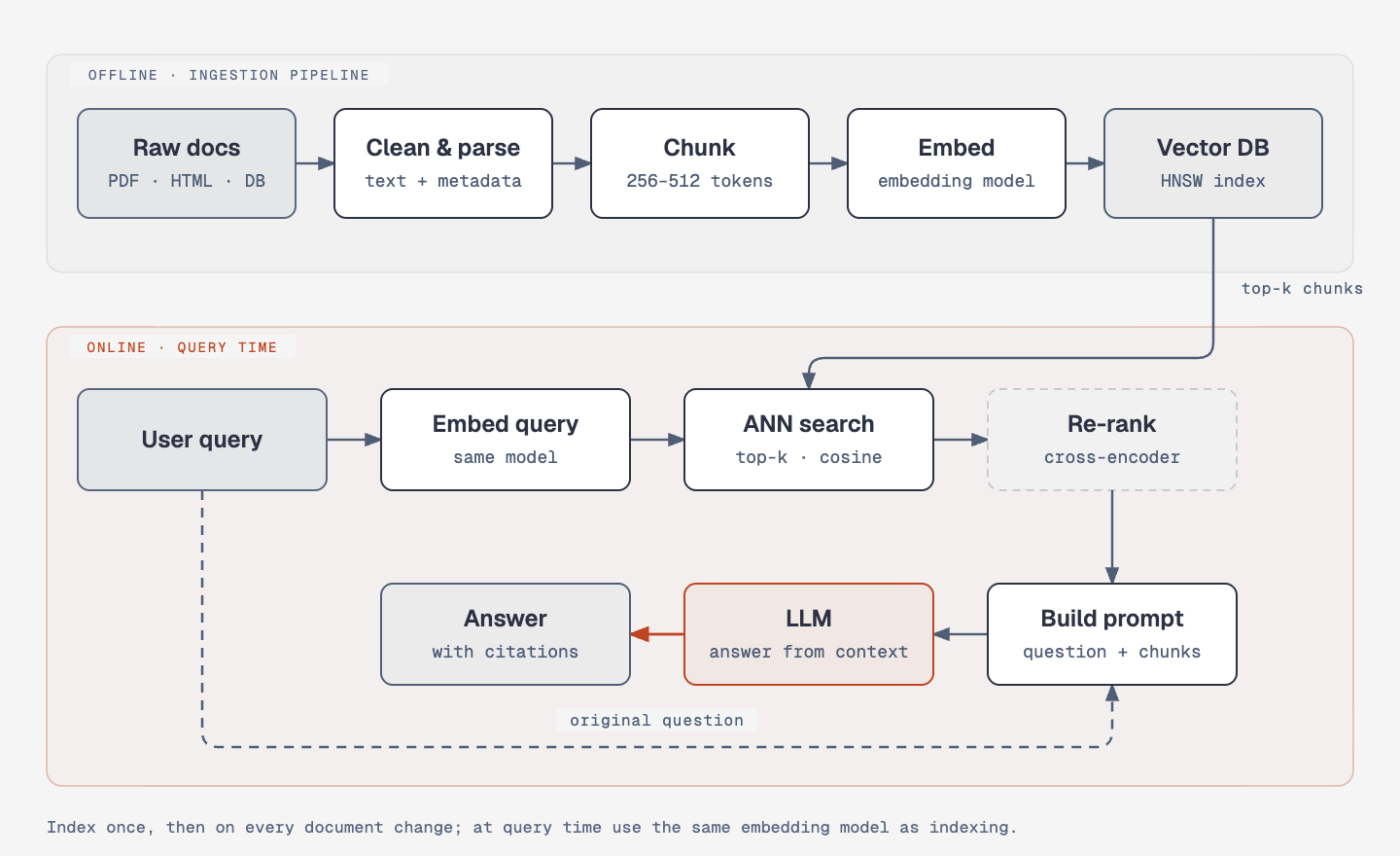
A RAG system has two distinct phases: indexing (offline) and querying (online). Let's trace both paths in detail.
Phase 1 — Indexing Your Knowledge Base
-
Document Ingestion — Raw documents (PDFs, HTML, Markdown, DOCX, database rows, Confluence pages, Slack threads) are collected from all sources. The breadth of your ingestion defines the breadth of what your AI can answer.
-
Chunking — Documents are split into smaller, semantically coherent segments. Chunk size matters: too small and you lose context, too large and retrieval precision suffers. Common strategies include fixed-size with overlap, sentence-boundary splitting, or recursive character splitting.
-
Embedding — Each chunk is passed through an embedding model (e.g. OpenAI text-embedding-3-large, Cohere Embed, or a self-hosted model), producing a high-dimensional vector that encodes the chunk's semantic meaning.
-
Vector Storage — Vectors are stored in a vector database (Pinecone, Weaviate, Qdrant, pgvector, ChromaDB). Alongside the vector, metadata — source URL, document date, author, category — is preserved for filtering at query time.
Phase 2 — The Query-Time Pipeline
- Query Reception — A user submits a natural language question: "What does our refund policy say about digital goods purchased after March 2025?"
- Query Embedding — The query is embedded using the same model used during indexing. This produces a query vector in the same semantic space as the document chunks.
- Approximate Nearest Neighbor (ANN) Search — The vector database performs a similarity search — typically cosine similarity or dot product — to find the top-k chunks whose vectors are closest to the query vector. This is fast: even across millions of vectors, ANN algorithms (HNSW, IVF, ScaNN) return results in milliseconds.
- Context Assembly — Retrieved chunks are ranked, possibly re-ranked using a cross-encoder model for higher precision, and assembled into a structured context block. Metadata may be injected (e.g. [Source: Policy Manual v3.2, Updated 2026-01-15]).
- Prompt Construction — The system prompt, retrieved context, and user query are composed into a final prompt sent to the LLM. The model is instructed to answer using only the provided context.
- Generation — The LLM generates a grounded, citation-aware response. Advanced implementations return source references, confidence indicators, and "I don't know" signals when context is insufficient.
A Practical Implementation
The following is a minimal but production-realistic RAG pipeline in Python using LangChain and OpenAI, wired to a Pinecone vector store. This illustrates every layer described above in approximately 60 lines of code.
# rag_pipeline.py — Minimal production RAG example
import os

from langchain_text_splitters import RecursiveCharacterTextSplitter
from langchain_openai import OpenAIEmbeddings, ChatOpenAI
from langchain_pinecone import PineconeVectorStore
from langchain_core.prompts import PromptTemplate
from langchain_core.output_parsers import StrOutputParser
from langchain_core.runnables import RunnableParallel, RunnablePassthrough
from pinecone import Pinecone

# ── 1. Connect to vector store ──────────────────────────────
pc = Pinecone(api_key=os.environ["PINECONE_API_KEY"])
index = pc.Index("company-knowledge-base")  # dimension 3072 for text-embedding-3-large

embeddings = OpenAIEmbeddings(model="text-embedding-3-large")
vectorstore = PineconeVectorStore(index=index, embedding=embeddings)

# ── 2. Indexing (run once, then incrementally on new docs) ──
def index_documents(documents: list[str], sources: list[str]) -> int:
    splitter = RecursiveCharacterTextSplitter(
        chunk_size=512,      # characters, not tokens
        chunk_overlap=64,    # overlap preserves cross-boundary context
        separators=["\n\n", "\n", ". ", " "],
    )
    chunks = splitter.create_documents(
        documents, metadatas=[{"source": s} for s in sources]
    )
    vectorstore.add_documents(chunks)
    return len(chunks)

# ── 3. Grounded prompt template ─────────────────────────────
RAG_PROMPT = PromptTemplate.from_template(
"""You are a helpful assistant. Answer ONLY from the
provided context. If the context does not contain enough
information, respond with "I don't have sufficient information."

Context:
{context}

Question: {question}
Answer:"""
)

# ── 4. Build the RAG chain (LCEL) ───────────────────────────
llm = ChatOpenAI(model="gpt-6-luna")  # GPT-4o leaves the OpenAI API on 14 Jan 2027
retriever = vectorstore.as_retriever(
    search_type="mmr",       # Max Marginal Relevance for diversity
    search_kwargs={"k": 6},  # retrieve 6 chunks
)

def format_docs(docs):
    return "\n\n".join(d.page_content for d in docs)

answer_chain = RAG_PROMPT | llm | StrOutputParser()
qa_chain = RunnableParallel(
    docs=retriever, question=RunnablePassthrough()
).assign(
    answer=lambda x: answer_chain.invoke(
        {"context": format_docs(x["docs"]), "question": x["question"]}
    )
)

# ── 5. Query ─────────────────────────────────────────────────
result = qa_chain.invoke("What is our refund policy for digital goods?")
print(result["answer"])
for doc in result["docs"]:
    print(f"  ↳ Source: {doc.metadata.get('source', 'unknown')}")
Note:
Grounding comes from the prompt and the retrieved context, not from temperature. A low temperature reduces variation, which helps when you want retrieved facts reproduced faithfully, but many current reasoning models (Claude Opus 4.7 and later, for example) reject a temperature setting altogether. Strict instructions and required citations do that job instead.
RAG vs. Fine-Tuning: When to Use Which
This is the most common architectural question teams face when deploying AI on proprietary data. The answer is nuanced — and the options are not mutually exclusive.
| Dimension | RAG | Fine-Tuning |
|---|---|---|
| Knowledge updates | Real-time; update the index | Requires retraining cycle |
| Cost | Inference + vector DB storage | High upfront compute; cheaper inference |
| Factual grounding | Strong; citable sources | Model may hallucinate nuanced facts |
| Tone / style adaptation | Weak without prompt engineering | Excellent; model learns the voice |
| Reasoning format | Unchanged from base model | Can be deeply customized |
| Data privacy | Data stays in your infrastructure | Data baked into model weights |
| Auditability | High; sources are traceable | Low; knowledge is opaque |
| Time to production | Days to weeks | Weeks to months |
The practitioner's rule of thumb:
Use RAG when the challenge is knowledge access, use fine-tuning when the challenge is behavioral adaptation. Many elite production systems do both: a fine-tuned model for domain-specific reasoning style, augmented with RAG for live knowledge retrieval.
RAG Failures and How to Avoid Them
RAG is powerful but not magic. Understanding its failure modes is essential for building systems that actually work in production.
- Retrieval failure: The right document exists in your corpus but doesn't get retrieved. This is the most common failure and cascades into a hallucinated answer. Mitigations: improve chunking, add hybrid search, invest in query rewriting, monitor retrieval precision with an evaluation set.
- Context window poisoning: Irrelevant or contradictory chunks retrieved alongside correct chunks confuse the model. Mitigations: strict re-ranking, aggressive metadata filtering, limiting retrieved chunks to a well-tuned k.
- Stale index: Documents are updated in the source system but the vector index is not refreshed. The model answers from outdated information with no awareness that it's doing so. Mitigations: event-driven indexing triggers, document version tracking, document-level deletion and re-indexing on update.
- Model ignoring context: The LLM dismisses retrieved context in favor of its parametric (training-time) knowledge, especially when training data contradicts the retrieved passage. Mitigations: explicit prompt instructions ("Answer ONLY from the provided context"), low temperature where the model accepts one, smaller/fine-tuned models that are more instruction-compliant.
- Semantic gap between query and document: Users phrase questions differently from how documents are written. A user asking "Can I get my money back?" may not match chunks containing "refund eligibility criteria." Mitigations: HyDE, query expansion, synonym-aware embeddings, human-curated test cases.
- Missing "I don't know": When no relevant context is retrieved, a poorly prompted model will fabricate an answer rather than admit ignorance. This is the most dangerous failure in high-stakes domains. Mitigations: explicit negative instruction in the system prompt, retrieval confidence thresholds, fallback responses.
Evaluating Your RAG System
You cannot improve what you cannot measure. RAG evaluation has two independent axes — retrieval quality and generation quality — and both must be tracked separately.
Retrieval Metrics
- Context Recall: Of all the relevant chunks that exist in your corpus, what fraction did your retriever actually return? Low recall means information the model needs is being left on the table.
- Context Precision: Of the chunks you retrieved, what fraction were actually relevant? Low precision poisons your context window with noise.
- MRR (Mean Reciprocal Rank): How highly ranked is the first relevant chunk? If the most relevant chunk is ranked 8th in a top-6 retrieval, it might as well not exist.
Generation Metrics
- Faithfulness: Does the answer make claims that are supported by the retrieved context? This is the primary anti-hallucination metric. Frameworks like RAGAS automate this assessment using an LLM judge.
- Answer Relevance: Does the answer actually address the question asked, or does it go off on tangents from retrieved context?
- Answer Correctness: Does the answer match a known ground truth? Requires a human-curated evaluation set but is the gold standard for production quality gates.
RAG Use Cases
RAG is not a general solution to every AI problem. It excels in a specific profile: factual question answering over a defined, updateable corpus with high accuracy requirements. The following use cases fit this profile almost perfectly.
Use Case 01
Internal Knowledge Base
Make HR policies, engineering runbooks, product specs, and onboarding materials queryable in natural language. Replace "ask your manager" with "ask the AI."
Use Case 02
Customer Support Copilot
Ground support agents' answers in your actual product documentation and support history. Reduce handle time and hallucination risk simultaneously.
Use Case 03
Legal & Compliance Q&A
Surface relevant clauses from contracts and regulations on demand, with source citations. High-stakes enough that auditability and faithfulness are non-negotiable.
Use Case 04
Code & API Documentation
Let developers query your internal APIs, SDKs, and architecture decisions in natural language, retrieving from your actual codebase and docs — not a model's approximation of them.
Use Case 05
Financial Intelligence
Retrieve from earnings reports, filings, analyst notes, and market data. Quantitative retrieval filters (date, ticker, metric type) pair powerfully with semantic search here.
Use Case 06
Medical & Research
Surface evidence from clinical literature, trial data, or drug databases. Faithfulness and source traceability are critical — RAG's citation capability makes it uniquely suited here.
RAG Production Architecture at Scale
A prototype RAG pipeline runs on a laptop. A production RAG system processing thousands of queries per hour looks considerably different.
The Ingestion Layer
At scale, document ingestion becomes an event-driven pipeline, not a one-time script. New documents trigger webhooks; updated documents trigger selective re-indexing. Apache Kafka or AWS EventBridge are common backbones. Parser workers handle format extraction (Unstructured.io, LlamaParse, or custom extractors for specific document types). Chunking and embedding workers run in parallel. Dead letter queues catch parsing failures. Everything is logged for debugging retrieval issues later.
The Serving Layer
Query latency is a first-class concern. ANN search in a well-configured vector DB is fast (single-digit milliseconds), but the full RAG pipeline — query embedding + ANN + re-ranking + LLM generation — can add up to 3–8 seconds. Caching semantically similar queries (using approximate deduplication of query embeddings) cuts latency for common questions dramatically. Streaming the LLM response improves perceived responsiveness even when total latency is high.
Observability
Every RAG query should be logged with: the raw query, the retrieved chunks and their scores, the final prompt, the generated answer, and user feedback signals (thumbs up/down, follow-up corrections). This trace data is the raw material for continuous improvement. Without it, you're flying blind.
Security and Access Control
In enterprise settings, not every user should be able to retrieve every document. Metadata filters or per-tenant namespaces in your vector store (Pinecone, Weaviate and Qdrant all support them), or a post-retrieval access-control check, prevent a junior employee from querying a document they wouldn't be able to open. This is a design requirement, not an afterthought.
Where RAG Is Heading?
The RAG landscape is moving fast. Several developments are reshaping what's possible and where the architecture is heading in 2026 and beyond.
Agentic RAG
Rather than a single retrieval-then-generate pass, agentic systems let the model decide when to retrieve, what to retrieve, and whether to refine its query based on what it found. This enables multi-hop reasoning — answering questions that require chaining several retrieval steps — at the cost of complexity and latency.
GraphRAG
Microsoft's GraphRAG approach builds a knowledge graph over your corpus in addition to a vector index. Graph traversal handles relationship-intensive queries ("How does Product A's pricing policy interact with Regulation B?") that flat chunk retrieval handles poorly. Computationally expensive to build but powerful for highly interconnected knowledge domains.
Multimodal RAG
As multimodal models mature, RAG is expanding beyond text. Image-text embeddings allow retrieval over product photographs, scanned documents, architectural diagrams, and charts. The same fundamental architecture applies — index, embed, retrieve, generate — but the modalities multiply.
Long-Context Models and RAG's Coexistence
Models with very large context windows (1M+ tokens) have prompted questions about whether RAG is still needed. The answer, empirically, is yes — for reasons of cost, latency, and the fact that stuffing an entire knowledge base into a context window every query is economically absurd. RAG and long context are complementary: RAG retrieves the relevant 1%, long context processes it with full nuance.
Retrieval-Augmented Generation has earned its place as a foundational pattern in enterprise AI architecture — not because it is exotic or cutting-edge, but because it solves a real, persistent problem with principled engineering. It separates the model's reasoning capability from your organization's knowledge, allowing both to evolve independently. It makes AI systems auditable, updatable, and factually accountable in a way that parametric models alone cannot be.
The teams that are building durable AI products are not chasing the largest model or the newest architecture. They are investing in the unglamorous work of high-quality ingestion pipelines, rigorous evaluation frameworks, thoughtful chunking strategies, and robust monitoring infrastructure. RAG is the architecture that makes that investment worthwhile.
⚡ Quick Reference
Keep the momentum going — everything you need on LearnXOps in one place:
- 🎓 Courses — Video courses & AI-built courses
- 📚 Ebooks — Community ebooks & your own
- 🧪 All Labs & Challenges — DevOps, Cloud, SRE & more
- ☸️ Kubernetes Labs & Playground — kind clusters, playground & challenges
- 🤖 AI Agent & Bot Labs — OpenClaw · Hermes · CrewAI · LangGraph · MCP


Member discussion