


We should learn the AWS Well-Architected Framework, it provides proven design principles to build secure, reliable, and cost-efficient cloud workloads.
Mastering it ensures they can balance trade-offs across performance, operations, and sustainability while guiding teams toward production-ready architectures.
⚡ Quick Reference
Keep the momentum going — everything you need on LearnXOps in one place:
- 🎓 Courses — Video courses & AI-built courses
- 📚 Ebooks — Community ebooks & your own
- 🧪 All Labs & Challenges — DevOps, Cloud, SRE & more
- ☸️ Kubernetes Labs & Playground — kind clusters, playground & challenges
- 🤖 AI Agent & Bot Labs — OpenClaw · Hermes · CrewAI · LangGraph · MCP
25% OFF on LearnXops Premium till 2nd October 2025
Only 40 slots left out of 100—grab yours now 🚀
Use code "DurgaPooja25
Pay Via CashFree or Topmate and get access to LearnXops Premium Content! ( E-books, Case Studies, Projects & more)
📚 Key Learnings
- Understand what the AWS Well-Architected Framework is and why it’s used to design and review cloud workloads.
- Learn how the framework helps identify risks, apply best practices, and build resilient systems.
- Understand trade-offs (e.g., cost vs performance) in cloud design.
🧠 Learn here
What is the AWS Well-Architected Framework?
The AWS Well-Architected Framework is a set of best practices, principles, and design pillars developed by AWS to help cloud architects build secure, high-performing, resilient, and efficient infrastructure for their applications. It provides a structured way to review and improve cloud workloads against industry standards.
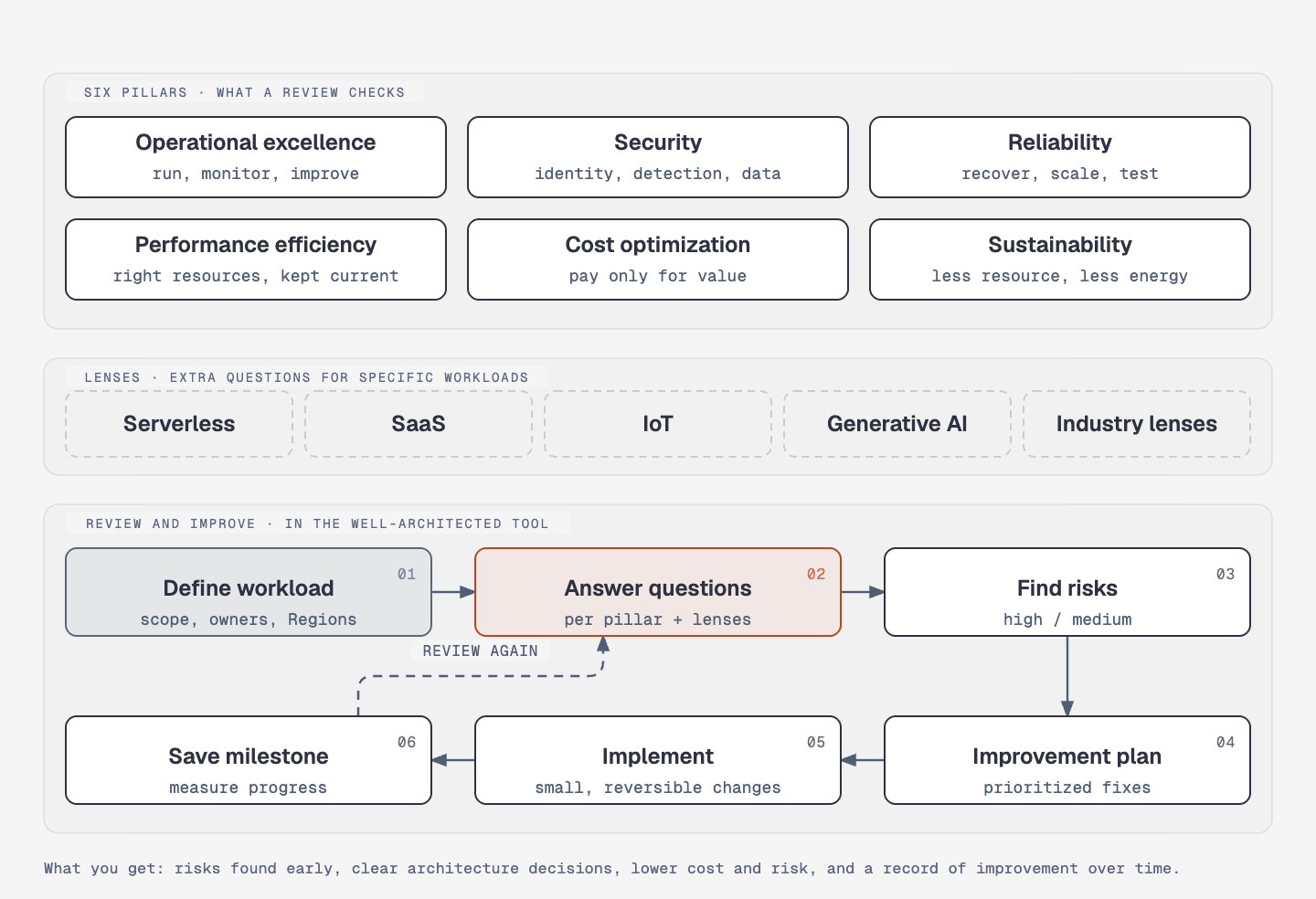
The framework is organized around six key pillars:
- Operational Excellence – Focus on operations, monitoring, and continuous improvement.
- Security – Protect data, systems, and assets through identity, detection, protection, and incident response.
- Reliability – Ensure workloads recover from failures and meet availability requirements.
- Performance Efficiency – Optimize resource use to meet requirements and adapt to changing demands.
- Cost Optimization – Control spending, eliminate waste, and scale efficiently.
- Sustainability – Minimize environmental impact by designing energy-efficient architectures.
Why is it used?
The AWS Well-Architected Framework is used to:
- Design Cloud Workloads: Helps architects apply AWS best practices while building new applications or migrating existing ones.
- Review Existing Architectures: Provides a structured review mechanism to identify risks, gaps, and areas of improvement.
- Ensure Alignment with Best Practices: Ensures workloads follow AWS-recommended patterns for scalability, security, and efficiency.
- Reduce Risks: Helps detect design flaws early, avoiding costly downtime or security breaches.
- Enable Continuous Improvement: Provides a repeatable process to maintain workloads as technology and business needs evolve.
- Cost and Sustainability Benefits: Encourages efficient use of resources to save costs and reduce environmental impact.
How it is Applied
- Well-Architected Tool (AWS Console): A free tool to review workloads against the framework.
- Well-Architected Reviews: Conducted by AWS or partners to assess workloads and provide remediation plans.
- Continuous Adoption: Teams use the framework throughout the workload lifecycle, not just during initial design.
Now, let's deeply understand each Pillar:
Operational Excellence
Operational Excellence is the first pillar of the AWS Well-Architected Framework. It focuses on running and monitoring systems effectively and continually improving processes and procedures to deliver business value.
Key Design Principles:
- Organize Teams Around Business Outcomes – Align team goals, ownership and priorities with what the business needs.
- Safely Automate Where Possible – Define operations as code (IaC) and automate them with guardrails.
- Implement Observability for Actionable Insights – Collect metrics, logs and traces tied to business outcomes.
- Make Frequent, Small, Reversible Changes – Reduce risk and enable quick rollbacks.
- Refine Operations Procedures Frequently – Evolve processes as workloads and requirements change.
- Anticipate Failure – Plan for failure, simulate it, and test recovery processes.
- Learn from All Operational Events and Metrics – Use post-incident analysis to improve systems.
- Use Managed Services – Let AWS run undifferentiated operations so teams focus on the workload.
Best Practices:
- Implement logging, monitoring, and alerting.
- Use automation for deployments and scaling.
- Regularly review operational metrics and incidents.
- Create playbooks and runbooks for incident management.
Benefits:
- Improved system reliability and availability.
- Faster incident detection and recovery.
- Continuous improvement culture for operations.
Security
Security is the second pillar of the AWS Well-Architected Framework. It focuses on protecting data, systems, and assets by applying strong security measures across every layer of the workload.
Key Design Principles
- Implement a Strong Identity Foundation – Use the principle of least privilege and enforce MFA.
- Maintain Traceability – Monitor, log, and audit actions across systems.
- Apply Security at All Layers – Secure network, application, and infrastructure layers.
- Automate Security Best Practices – Use tools and scripts for consistent enforcement.
- Protect Data in Transit and at Rest – Use encryption and data classification.
- Keep People Away from Data – Use tools and automation instead of direct access to data.
- Prepare for Security Events – Develop incident response plans and test them regularly.
Best Practices:
- Use IAM roles and policies to manage permissions.
- Apply encryption with AWS KMS and TLS.
- Enable AWS CloudTrail, GuardDuty, and Security Hub.
- Regularly patch and update systems.
- Implement WAF and Shield for protection against attacks.
Benefits:
- Reduced risk of unauthorized access.
- Compliance with regulatory requirements.
- Stronger resilience against evolving threats.
Reliability
Reliability is the third pillar of the AWS Well-Architected Framework. It ensures that workloads function correctly and consistently, even when components fail, and can recover quickly from disruptions.
Key Design Principles
- Automatically Recover from Failure – Implement automation to detect and recover.
- Test Recovery Procedures – Regularly simulate failures and test disaster recovery.
- Scale Horizontally to Increase Availability – Distribute workloads across multiple resources.
- Stop Guessing Capacity – Use auto scaling to handle demand changes.
- Manage Change in Automation – Use version-controlled, automated deployments.
Best Practices:
- Deploy workloads across multiple Availability Zones (AZs).
- Use load balancers and failover mechanisms.
- Backup data regularly and test restores.
- Implement monitoring and automated healing.
- Apply chaos engineering to test reliability.
Benefits:
- High availability and minimal downtime.
- Resilient systems capable of handling failures.
- Confidence in meeting SLA and business continuity requirements.
Performance Efficiency
Performance Efficiency is the fourth pillar of the AWS Well-Architected Framework. It focuses on using computing resources efficiently and adapting to changing requirements with evolving technologies.
Key Design Principles
- Democratize Advanced Technologies – Use managed services to adopt innovations easily.
- Go Global in Minutes – Deploy workloads globally with AWS Regions and Edge locations.
- Use Serverless Architectures – Reduce operational overhead and scale on demand.
- Experiment More Often – Test different configurations and approaches frequently.
- Consider Mechanical Sympathy – Use the right technology for the workload.
Best Practices:
- Choose the right instance types and storage options.
- Use caching mechanisms like Amazon CloudFront and ElastiCache.
- Optimize database queries and schema.
- Monitor performance metrics and optimize regularly.
- Use autoscaling to handle variable workloads.
Benefits:
- Improved application responsiveness and scalability.
- Efficient use of computing resources.
- Ability to quickly adapt to business and user demands.
Cost Optimization
Cost Optimization is the fifth pillar of the AWS Well-Architected Framework. It ensures that workloads are designed and operated in the most cost-effective way without sacrificing performance or security.
Key Design Principles:
- Implement Cloud Financial Management – Build cost awareness, ownership and processes across teams.
- Adopt a Consumption Model – Pay only for what you use.
- Measure Overall Efficiency – Measure business output relative to cost.
- Stop Spending on Undifferentiated Heavy Lifting – Use managed services instead of self-hosting.
- Analyze and Attribute Expenditure – Tag resources for cost tracking.
Best Practices:
- Use AWS Cost Explorer, Budgets, and Trusted Advisor.
- Rightsize instances and storage based on usage.
- Use Reserved Instances and Savings Plans for predictable workloads.
- Enable auto scaling to optimize usage.
- Decommission unused resources.
Benefits:
- Reduced cloud spend without compromising performance.
- Clear visibility and accountability for costs.
- Long-term cost savings and efficient resource allocation.
Sustainability
Sustainability is the sixth pillar of the AWS Well-Architected Framework. It focuses on minimizing the environmental impact of cloud workloads by using resources efficiently and adopting eco-friendly practices.
Key Design Principles:
- Understand Your Impact – Measure the environmental impact of workloads.
- Establish Sustainability Goals – Set targets for energy and resource efficiency.
- Maximize Utilization – Use resources efficiently to minimize waste.
- Anticipate and Adopt New, More Efficient Technologies – Continuously evolve to greener options.
- Use Managed Services – Leverage AWS services designed for sustainability.
Best Practices:
- Choose Regions powered by renewable energy.
- Use serverless and container services to maximize efficiency.
- Monitor resource usage and carbon footprint.
- Optimize code and architecture for lower resource consumption.
- Use autoscaling to reduce idle resources.
Benefits:
- Reduced carbon footprint of workloads.
- Lower operational costs through efficient usage.
- Alignment with organizational sustainability goals and compliance requirements.
Lenses
Lenses in the AWS Well-Architected Framework are specialized extensions that provide guidance for specific types of workloads, technologies, or industries. While the core framework applies broadly, lenses dive deeper into unique considerations relevant to particular scenarios.
Purpose of Lenses:
- Customize the Framework – Adapt the Well-Architected Framework to specific workloads.
- Address Unique Challenges – Provide targeted best practices for specialized domains.
- Enhance Reviews – Allow architects to perform more relevant and detailed workload assessments.
Examples of AWS Well-Architected Lenses:
- Serverless Applications Lens – Best practices for event-driven, serverless workloads.
- High Performance Computing (HPC) Lens – Guidance for compute-intensive scientific and engineering workloads.
- Machine Learning (ML) Lens – Optimizing ML workflows, model training, and inference on AWS.
- Generative AI Lens – Building, deploying and operating generative AI applications, including agentic workflows.
- Responsible AI Lens – Fairness, explainability, safety and governance for AI systems (added November 2025).
- IoT Lens – Best practices for IoT workloads connecting devices at scale.
- SaaS Lens – Designing secure, multi-tenant SaaS solutions.
- Financial Services Industry (FSI) Lens – Meeting compliance, security, and resiliency for financial applications.
How Lenses Are Used:
- Select the Relevant Lens – Choose the lens that aligns with the workload domain.
- Conduct Lens-Specific Review – Assess the workload using lens-specific questions and best practices.
- Implement Remediations – Apply recommendations to improve workload alignment with AWS best practices.
Benefits:
- Tailored best practices for specific use cases.
- Improved workload design beyond general guidance.
- Faster adoption of specialized AWS services.
Understanding Trade-Offs
In cloud architecture, trade-offs are conscious decisions made to balance competing priorities such as cost, performance, security, and reliability. The AWS Well-Architected Framework emphasizes understanding these trade-offs to design workloads that best meet business and technical requirements.
Why Trade-Offs Matter?
- Every workload has constraints: budget, compliance, performance, or operational efficiency.
- Making deliberate trade-offs helps avoid over-engineering or under-provisioning.
- Understanding trade-offs ensures workloads align with both business goals and technical best practices.
Common Trade-Offs in Cloud Design
- Cost vs Performance – Using higher-performance resources may improve speed but increase costs; using smaller or fewer resources saves cost but may impact responsiveness.
- Reliability vs Efficiency – Highly available, fault-tolerant architectures (multi-AZ, multi-region) may require extra resources, which reduces efficiency.
- Security vs Usability – Stronger security (e.g., strict IAM policies, MFA, encryption) may increase complexity for users and developers.
- Time-to-Market vs Robustness – Faster delivery may involve fewer optimizations, while robust designs may require more time.
- Flexibility vs Complexity – Building highly flexible systems may increase architectural complexity.
Best Practices for Managing Trade-Offs
- Define Priorities Early – Understand business goals and requirements.
- Use Data to Decide – Rely on metrics (performance, cost, latency, etc.) rather than assumptions.
- Leverage AWS Tools – Use Cost Explorer, Trusted Advisor, CloudWatch, and Well-Architected Tool for insights.
- Iterate Continuously – Reassess trade-offs as workloads evolve.
Benefits:
- Optimized workloads tailored to organizational priorities.
- Informed decision-making backed by data.
- Balanced architectures that maximize value while minimizing risks.
Challenges
- Summarize the six pillars in your own words.
- Perform a Well-Architected Review of a test workload using the AWS tool.
- Identify two risks from the review and write down remediation steps.
- Apply framework principles to an existing architecture diagram and note improvements.
- Explore a lens from the Lens Catalog (e.g., Serverless, Machine Learning or Generative AI Lens) and summarize findings.
- Advanced: Read the Full Well-Architected Framework White Paper
🤷🏻 How to Participate?
✅ Complete the tasks and challenges.
✅ Document your progress and key takeaways on GitHub ReadMe, Medium, or Hashnode.
✅ Share the above in a LinkedIn post tagging me (Sandip Das), and use #90DaysOfCloud to engage with the community!
⚡ Quick Reference
Keep the momentum going — everything you need on LearnXOps in one place:
- 🎓 Courses — Video courses & AI-built courses
- 📚 Ebooks — Community ebooks & your own
- 🧪 All Labs & Challenges — DevOps, Cloud, SRE & more
- ☸️ Kubernetes Labs & Playground — kind clusters, playground & challenges
- 🤖 AI Agent & Bot Labs — OpenClaw · Hermes · CrewAI · LangGraph · MCP


Member discussion